A machine learning model only creates value if it runs in production, on your equipment, every day. OIAnalytics takes you from model to large-scale deployment.
What Python model execution does
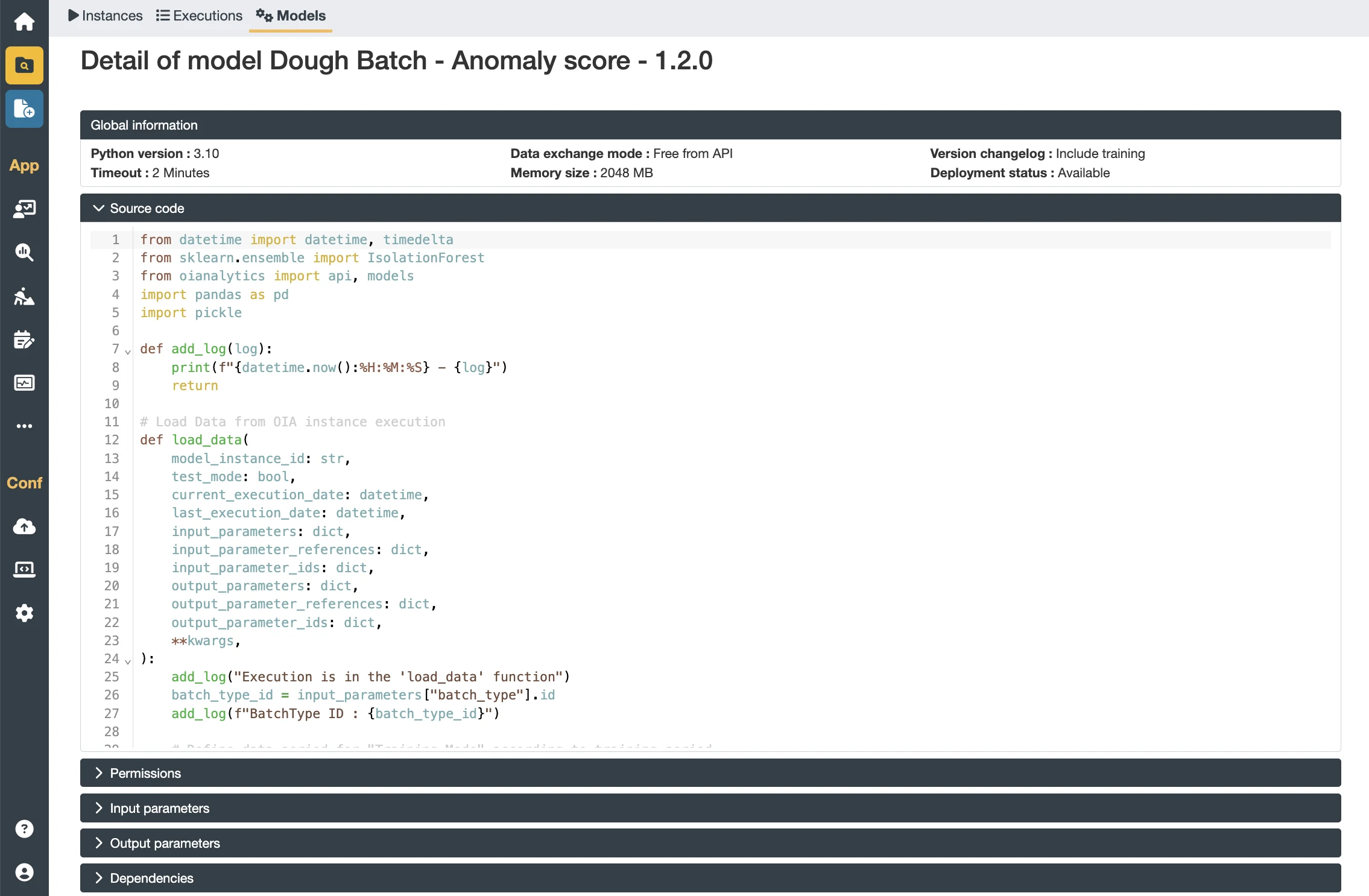
OIAnalytics runs your Python programs directly in the platform. They read time series, batches, events and files, then write their results back as new data, immediately available across every application in the solution (dashboards, controls, alerts…).
Typical use cases: anomaly detection, predictive quality, setpoint recommendation to hit a quality target, consumption forecasting…
What you gain
From prototype to production with no IT project: no infrastructure to build, no scheduler to manage, no connectors to write.
Results that are useful right away: anomaly scores and predicted quality show up in dashboards and trigger alerts.
Fleet-wide deployment: a model developed once monitors as many assets as needed (for example 10 heat exchangers with 10 instances).
Complete modeling freedom: mechanistic, ARIMA/SARIMA, regression, trees, random forests, XGBoost, SVM, neural networks, deep learning, scientific computing, optimization, operations research…
Key features
Isolated execution in a Docker container on an auto-scaling compute architecture; scheduled (CRON), manual or file-triggered runs.
Many Python libraries available (pandas, NumPy, scikit-learn, Keras, PyTorch…), declared at configuration time.
Parameters managed at three levels: in the code, at model level (shared by all instances) or per instance.
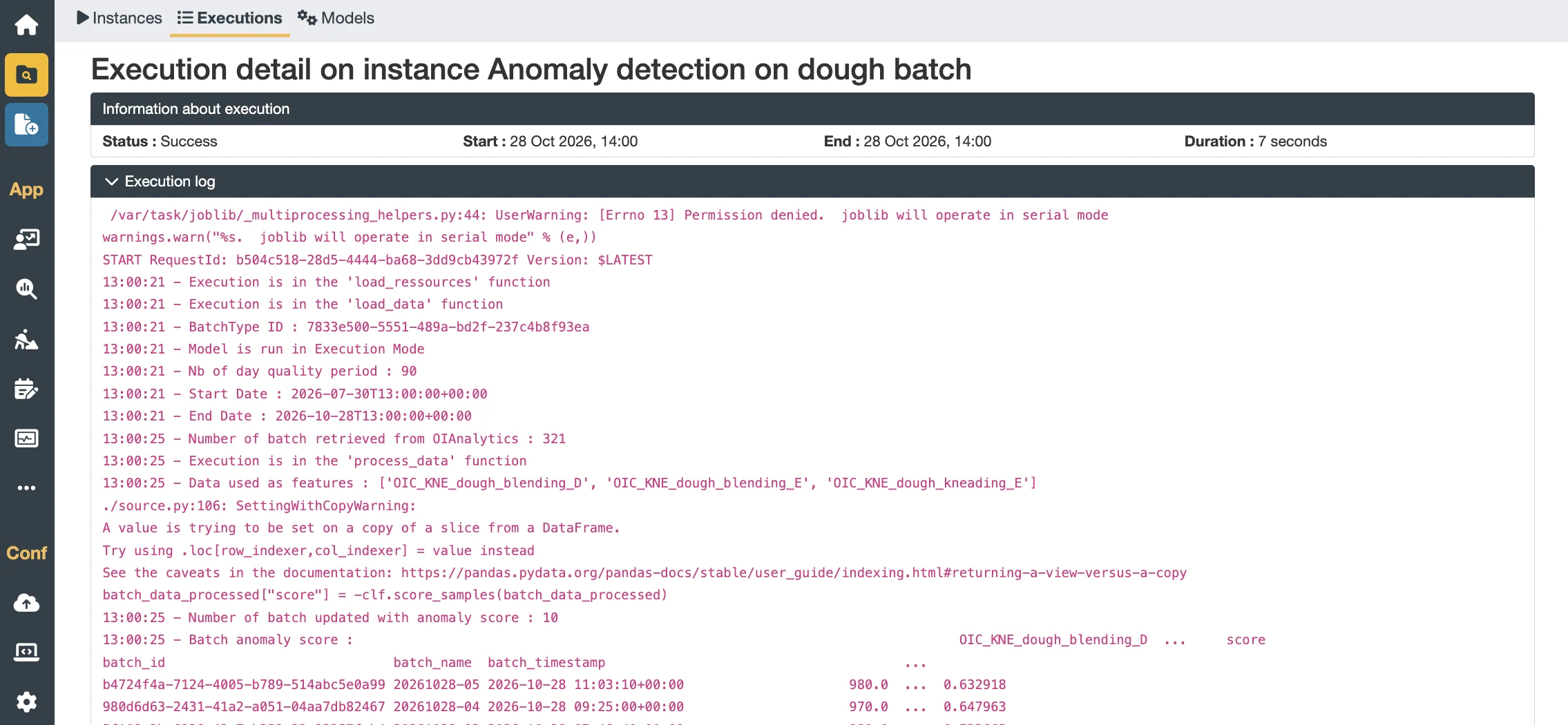
Execution monitoring: filterable run history and detailed reports (logs, errors, input and output data).
Automatic instance generation per asset type: attach a model to an equipment type and every new piece of equipment gets its own instance, with its own parameters and files (for example, its trained weights).
Model quality under control: quality indicators computed at each run can trigger alerts, events or automatic retraining.
Model marketplace: share a model privately, with selected platforms or publicly, and reuse models from Optimistik and its partners without duplicating code.
AI-assisted development in the AI Notebook, a Jupyter-like environment connected to your data.