Without context, raw data carries little information and is hard for teams to use. The OIAnalytics contextualization engine gives meaning to your industrial data and makes it instantly usable by everyone.
What the contextualization engine does
The contextualization engine continuously integrates, structures, stores and transforms all your industrial data in a single repository shared by every application of the platform. It relies on ready-to-use data models designed specifically for process manufacturing:
Time series, numerical or text, from sensors, PLCs and DCS.
Traceability: batches, campaigns and equipment cycles, with their phases, recipes and equipment used.
Genealogy: the sequence of production steps and intermediate products, from raw materials to finished goods.
Events: stoppages, tool changes, cleaning, alarms, categorized with your own tree (type, family, cause).
Assets: asset templates (equipment, lines, workshops…) with their full context (data, calculations, characteristics…), which automatically generate the configuration of each new asset from the template.
Vector data: to handle complex data such as NIR, Raman or UV spectra, chromatograms or vibration spectra.
To make it easy to bring your data into OIAnalytics, the contextualization engine offers extensive transformation capabilities that continuously map it to the data model.
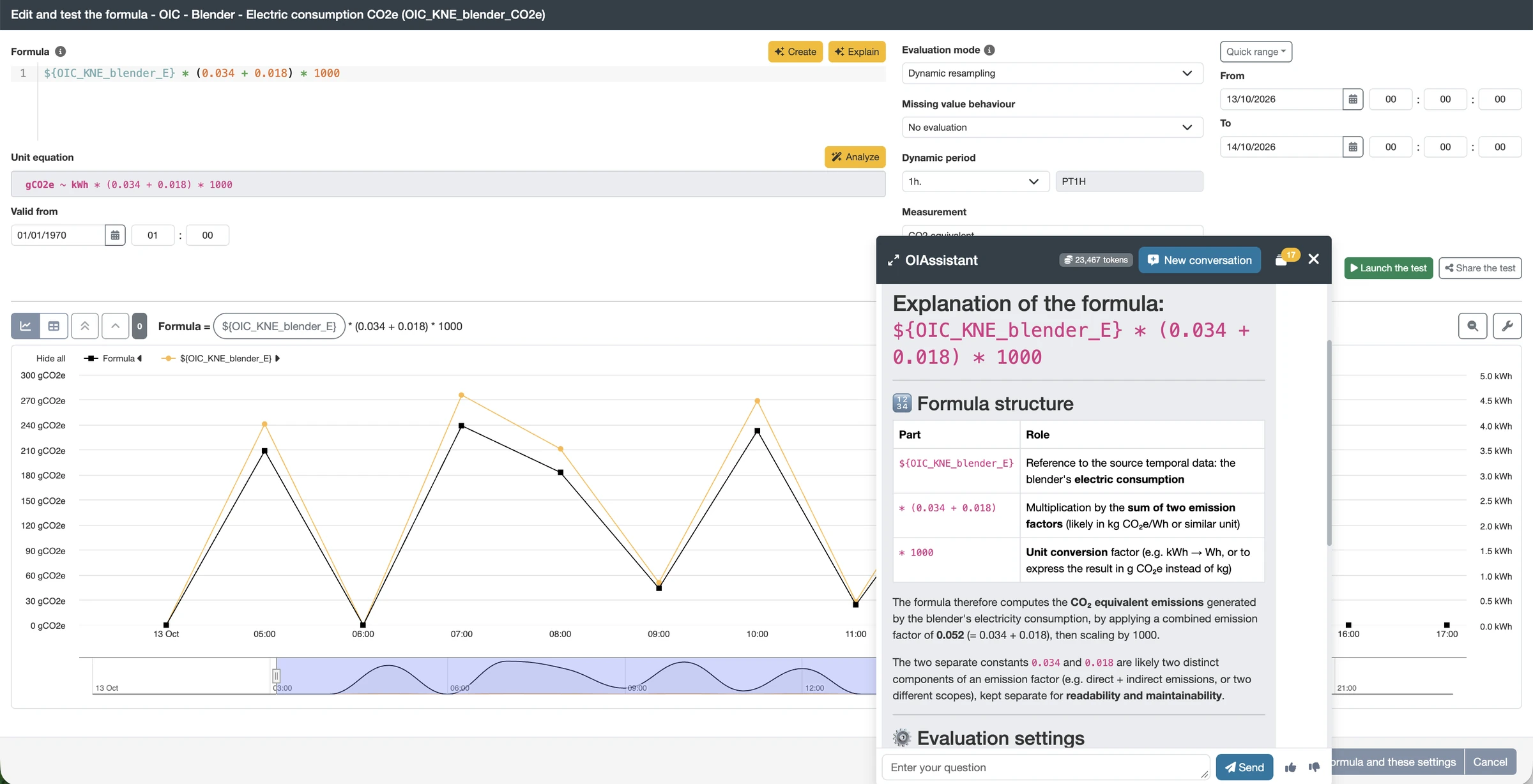
Its no-code calculation engine turns this data into business KPIs: key performance indicators, energy performance indicators, technical characteristics… With a rich and varied set of calculation functions, the possibilities are almost limitless.
What you gain
No more data preparation: teams directly access data continuously organized by batch, recipe, shift, product or equipment.
Accurate KPIs: yield per batch or drift over a production campaign can only be calculated with the right context.
Silos broken down: production, quality, maintenance and management share the same trusted data source.
Autonomy and agility: process experts evolve the repository themselves. They can safely test and adjust new approaches to contextualizing their data for new use cases.
Easier compliance: audit trail across the entire contextualization engine configuration.
Key features
A patented approach to industrial data contextualization, storage and transformation.
Automatic context generation when source systems do not provide it: batches, cycles, phases, stoppages or campaigns are detected from PLC states, thresholds or transitions, without changing existing systems.
Native contextual calculations: aggregation by batch, phase or event, consolidation along the genealogy, with a wide choice of calculation functions (arithmetic, statistical, logical, mathematical, thermodynamic tables…).
Simplified calculations: an AI-assisted tool to design your calculation formulas, explain them and check unit consistency. Testing features let you immediately confirm they return the expected results.
Native handling of physical quantities, units and conversions.
Mass configuration through the asset concept.
A data model whose flexibility has been proven on several hundred industrial sites across a wide range of activities.
Fully open: all raw and computed data is available through the API.