Industrial plants generate more data today than at any point in history, but extracting value from that data has become a monumental IT and operational challenge. Over the past decade, the rush to digitalize created severe "tool fatigue." CIOs, COOs, and Plant Managers now find themselves managing a tangled web of legacy databases, specialized analytics tools, and disconnected dashboards.
This architectural fragmentation drives up software licensing costs, creates maintenance overhead for IT, and traps critical operational context in isolated silos.
This article outlines how to simplify your industrial software architecture with a Manufacturing Performance Intelligence (MPI) solution. By clearly defining what to preserve, what to consolidate, and how a unified platform approach bridges the gap between control and strategy, enterprises can significantly lower total cost of ownership while accelerating time-to-insight.
A modern, streamlined software stack does not require a "rip-and-replace" approach to core operational tech. A Manufacturing Performance Intelligence solution is built to sit cleanly above your mission-critical transactional and real-time control layers, listening, ingesting and exchanging without interfering in plant operations:
The primary source of architectural friction in manufacturing lies in the middle layer—the sprawling ecosystem of point solutions sitting between raw plant control and executive decision-making. A Manufacturing Performance Intelligence solution consolidates these redundant systems into a unified environment.
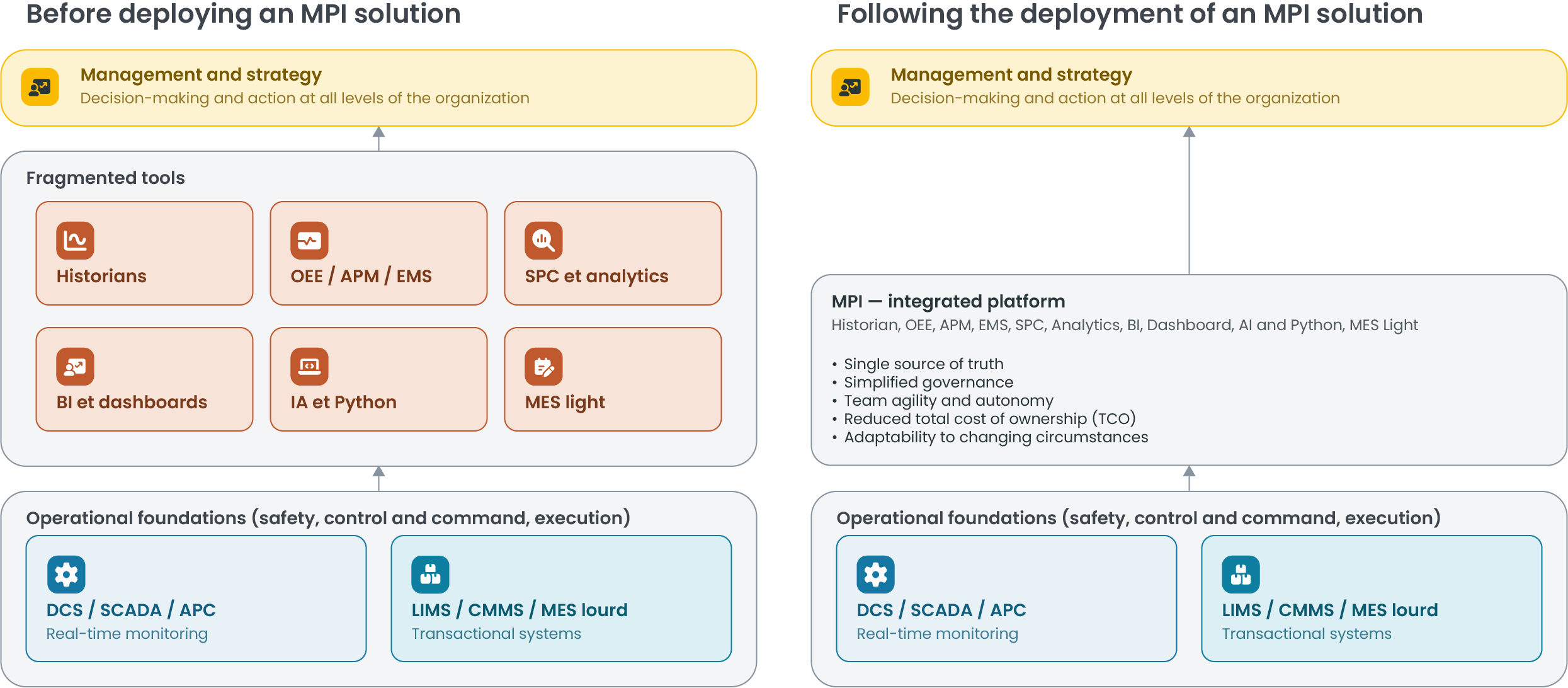
The Bloated Middle: Traditional historians were designed decades ago for basic data logging. Today, they often suffer from expensive tag-based licensing, proprietary data lock-in, heavy on-premise infrastructure requirements, and slow interface speeds when querying long-term historical trends.
The MPI Substitution: Replaces legacy historians with a high-throughput, modern time-series engine. It makes data instantly accessible across the enterprise. Beyond flat data logging, a comprehensive MPI solution opens entirely new operational possibilities through modern contextualization—structuring raw data feeds around Traceability, Genealogy, Assets, and Events to turn unstructured data points into immediate, actionable intelligence.
The Bloated Middle: Purchasing separate, standalone software modules for Overall Equipment Effectiveness (OEE), Asset Performance Management (APM), and Energy Management Systems (EMS) creates data islands. Each tool maintains its own master data, requires separate user training, and forces engineers to manually correlate insights across multiple applications.
The MPI Substitution: Calculates OEE, monitors asset health, and tracks energy consumption natively within a single platform. By evaluating throughput, asset health, and energy intensity on the same timeline, operations teams gain a complete, holistic view of performance.
The Bloated Middle: Niche diagnostic analytics and statistical process control (SPC) software often require steep learning curves, separate licensing models, and complex ETL pipelines. As a result, advanced analytics remain confined to a small group of data scientists or process specialists.
The MPI Substitution: Democratizes process statistics, optimization and root-cause analysis directly within the operational interface. Engineers can run control cards, perform advanced correlation analysis, and investigate anomalies without exporting data to third-party statistical packages.
The Bloated Middle: Generic business intelligence (BI) tools and spreadsheets are optimized for relational, static, or financial data—not high-frequency process data. Exporting process data into these tools strips away live operational context, causes massive performance lag, and creates version-control liabilities.
The MPI Substitution: Replaces static BI reporting with native, real-time industrial visualization designed specifically for process data. Dashboards remain linked directly to the underlying data streams and context, providing interactive, context-rich visibility from the shop floor to the executive desk.
The Bloated Middle: Deploying custom machine learning models or Python scripts typically requires standing up entirely separate IT infrastructure—such as standalone MLOps platforms, custom Docker containers, or dedicated edge computing servers. This creates a painful "deployment gap" between the data scientists who build the models offline and the operational systems that need those models for real-time inference.
The MPI: Eliminates the need for external AI hosting by natively embedding Python execution directly within the platform. Data scientists and engineers can deploy their custom models, algorithms, or machine learning inferences right on top of the live, contextualized time-series data. This turns AI from a complex integration project into a native platform capability, running seamlessly alongside standard process data.
The Bloated Middle: While a "Heavy MES" is a necessary transactional foundation for highly complex manufacturing, many process and utility plants only need basic production tracking. To achieve this, they often deploy "MES Light" solutions simply to digitize paper records, track basic batch genealogy, or log manual operator observations. This introduces yet another database and user interface that sits awkwardly between the control system and the historian.
The MPI: By leveraging its advanced contextualization capabilities—specifically Traceability, Genealogy, and Event tracking—a Manufacturing Performance Intelligence solution naturally absorbs the core functionalities of an MES Light. With integrated forms and dashboards, production teams can track batch execution, capture manual operator inputs, and link production runs directly to live time-series data and LIMS quality results. This achieves a paperless, digitized production flow without the integration overhead of a standalone MES application.
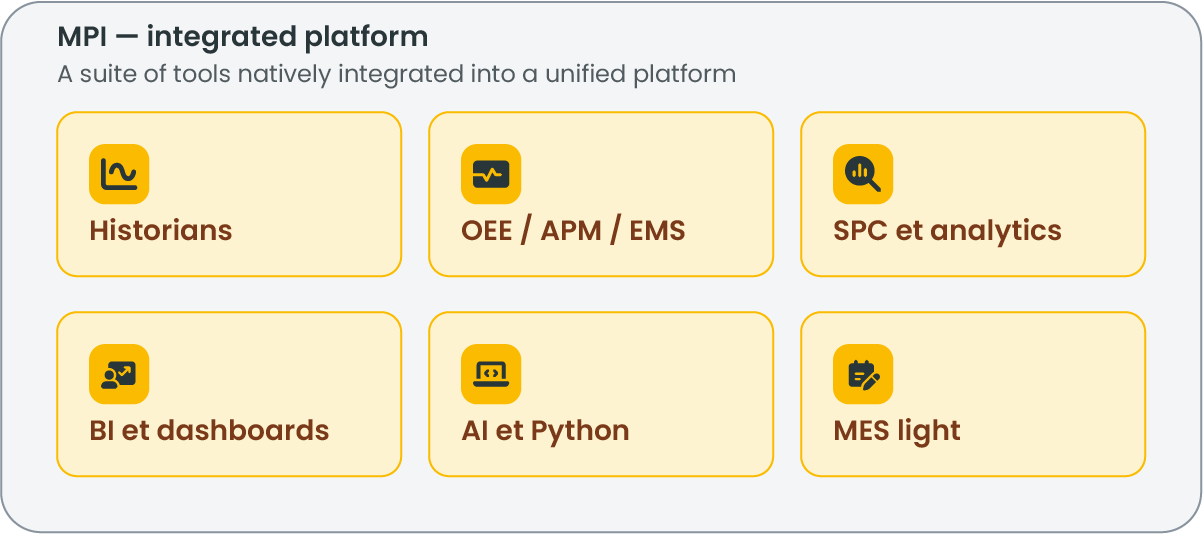
Unifying data storage, process analytics, domain applications, AI deployment and real-time visualization into a single platform shifts the organization from a fragmented "app" mindset to a cohesive platform strategy. For executive leadership, this convergence yields three strategic advantages: